
KENJO CHIBA

KENJO CHIBA
[English follows Japanese]
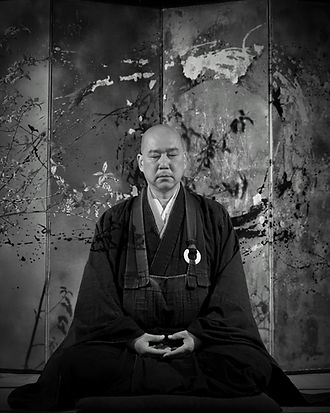
臨済宗建長寺派・栖足寺33世住職、千葉兼如。
1974年東京生まれ。33歳で仏門への出家を決意し、三島龍澤僧堂にて後藤榮山老大師に参禅。
修行と副住職を経て、2013年に静岡伊豆河津の栖足寺住職に就任。
禅僧として、禅の精神を後世に伝えていく責任を担う。
禅の象徴である「円相」をモチーフに、伝統的な禅の思想を現代的なデザインへと昇華する。
禅の本質をシンプルで力強い表現に落とし込み、国や文化を越えて、現代を生きる人々へ禅の精神を届ける。
Kenjo Chiba is the 33rd chief priest of Sokusoku-ji Temple, belonging to the Kencho-ji branch of the Rinzai Zen school.
Born in Tokyo in 1974, he decided at the age of 33 to enter the Buddhist monastic path. He trained at Ryutaku Monastery (Ryutaku Sōdō) in Mishima under Zen Master Goto Eizan Roshi.
After years of practice and service as vice-priest, he was appointed chief priest of Sokusoku-ji Temple in Kawazu, Izu (Shizuoka) in 2013.
As a Zen monk, he carries the responsibility of transmitting the spirit of Zen to future generations.
Using the Ensō, the symbolic circle of Zen, as a central motif, he elevates traditional Zen philosophy into a contemporary visual language.
Through simple yet powerful expressions that distill the essence of Zen, his works convey the spirit of Zen to people living in the modern world, beyond national and cultural boundaries.

円相/ENSŌ
円相(えんそう)とは、禅の思想を象徴する円の図形です。禅僧が墨を含ませた筆を取り、呼吸を整え、一息で描き上げる一筆の円を指します。
円相は単なる丸ではありません。禅における悟り、空(くう)、無限、宇宙、そしてとらわれのない心を象徴する形とされています。
円には始まりも終わりもなく、欠けるところも余るところもありません。その完全な循環の形の中に、禅は「円満」「無限」「真理」といった概念を見いだし、単純な形の中に、言葉を超えた真理が込められているのです。
しかし、円相は必ずしも完璧な円である必要はありません。あえて途切れを残した円や、歪みやかすれを含んだ円も多く描かれます。それは、不完全さもまた自然の一部であり、世界のありのままの姿であるという禅の考えを表しています。
円相は一度きりの筆致で描かれ、描き直しや修正は行われません。そのため、描かれた円相は、その瞬間の精神状態や心の在り方を映し出すものとされています。
禅では、言葉では説明できない真理を直接示すことが重視されます。円相は、その真理を象徴的に示す「かたち」として、古くから禅僧たちによって描かれてきました。
歴史
円相の起源は、中国唐代の禅僧・南陽慧忠(なんようえちゅう)国師に遡るとされます。慧忠は、言葉では表せない真理を一つの円によって示しました。これが「一円相」と呼ばれ、禅の象徴として広まっていきました。
その後、日本に禅宗が伝来すると、円相は多くの禅僧によって描かれるようになります。
江戸時代には
* 白隠慧鶴
* 仙厓義梵
といった禅僧が個性的な円相を描き、多くの人々に親しまれました。
白隠の円相は力強く、精神のエネルギーを感じさせるものです。仙厓の円相はユーモアに富み、時に言葉を添えることで、禅の思想を親しみやすく伝えました。
円相の意味
円相は見る人に答えを与えるものではなく、問いを投げかけます。
この円は完成しているのか。それとも未完成なのか。
意味があるのか。それとも意味はないのか。
その曖昧さと余白の中で、人は自分自身の心と向き合います。
円相は、禅の思想を一つの形に凝縮した表現なのです。
What is an Ensō?
Ensō is a circular symbol that represents the essence of Zen Buddhism.It is traditionally drawn by a Zen monk using a brush dipped in ink, executed in a single, uninterrupted stroke.
However, an Ensō is far more than a simple circle.
In Zen philosophy, the circle symbolizes enlightenment, emptiness (śūnyatā), the universe, and a mind that is free from attachment.
A circle has no beginning and no end.It lacks nothing and contains nothing unnecessary.For this reason, Zen practitioners saw in the circle a symbol of completeness, infinity, and ultimate truth.
Interestingly, an Ensō does not always have to be a perfect circle.Some Ensō are intentionally left open, while others appear uneven or imperfect.
These variations reflect an important Zen idea:imperfection and incompleteness are also natural aspects of existence.
An Ensō is drawn in a single moment and cannot be corrected or redrawn.Because of this, the circle is often said to reveal the state of mind of the person who created it.
In Zen, truth cannot always be explained through words.Instead, it is sometimes expressed through direct action or form.The Ensō became one of the most powerful visual expressions of this principle.
Historical Background
The origin of the Ensō is often traced back to the Tang dynasty Zen master Nanyang Huizhong in China.
He used the image of a circle to represent a truth that could not be fully explained through language.This simple yet profound symbol later became widely associated with Zen teachings.
When Zen Buddhism spread to Japan, the practice of drawing Ensō continued to evolve.
During the Edo period, Zen monks such as Hakuin Ekaku, Sengai Gibon became well known for their expressive and unique Ensō paintings.
Hakuin’s circles are powerful and dynamic, reflecting intense spiritual energy.Sengai’s works, on the other hand, often include humor and playful inscriptions that make Zen philosophy accessible to a broader audience.
The Meaning of Ensō
An Ensō does not give a fixed answer.Instead, it invites the viewer to contemplate.
Is the circle complete?Or is it unfinished?
Does it have meaning?Or is it beyond meaning?
In this open space of interpretation, each viewer encounters their own mind.
For this reason, the Ensō remains one of the most profound visual expressions of Zen philosophy.
[English follows Japanese]


〈展覧会歴〉
2023年5月、「アートで伝える仏教」、開国下田みなとギャラリー(静岡・下田)
2023年7月、「龍画展」、パルテノン多摩ギャラリー(東京)
2023年11月、「龍-祈りと安穏」、つぼみ堂(京都)
2024年3月、「水墨無常ー現代水墨表現ー」呉一騏・千葉兼如(二人展)、鎌倉大本山建長寺(鎌倉)
2024年4月、「龍画展」、熱川プリンスホテル (静岡・熱川)
2024年6月、「禅」、吉祥 美術倶楽部 (大阪)
2024年6月、「円相」、エンソー アート ギャラリー(メノルカ島・スペイン)
2024年11月 「円相 ワークショップ」、大阪箕尾 勝尾寺
2024年11月、「流墨自然-現代墨相表現展」、那谷寺内 国重要文化財「書院」
2025年7月 「Zen-Cube 発表展覧会」、三島 Gallery701
2025年10月 「布 墨 銀 Fabric Sumi ink Silver」、静岡伊勢丹 コリドー・フジ
2025年11月 「布 墨 銀 Fabric Sumi ink Silver」、臨済宗 建長寺派 萬松山 崇禅寺
2025年12月 「布 墨 銀 Fabric Sumi ink Silver」、鎌倉大本山建長寺
2026年1月 「「自由自在」」、TSUBOMIDO 京都
Solo Exhibitions:
May 2023 - "Buddhism Through Art" at Kaikoku Shimoda Minato Gallery (Shizuoka, Shimoda)
July 2023 - "Dragon Art Exhibition" at Parthenon Tama Gallery (Tokyo)
November 2023 - "Dragon - Prayer and Tranquility" at Tsubomido (Kyoto)
March 2024 - "Ink and Water - a contemporary Shiboku expression" at Kenchō-ji Temple (Kamakura)
April 2024 - "Dragon" at Atagawa Prince Hotel (Shizuoka, Atagawa)
June 2024 - "ZEN" at Auspicious Art (Osaka)
June 2024 - "Ensō" at Ensō Art Gallery (Mahón, Menorca, Spain)
November 2024 - “Enso Workshop”, Katsuo-ji Temple, Minoh, Osaka
November 2024 - "Flowing ink Nature - Modern Bokuso Expression" Natadera Temple"
July 2025: - Zen-Cube Presentation Exhibition”, Gallery701, Mishima
October 2025: "Fabric Sumi ink Silver", ISETAN Corridor-Fuji
November 2025: "Fabric Sumi ink Silver", Banshozan Shuzenji Temple (Gunma)
December 2025: "Fabric Sumi ink Silver", Kencho-ji Temple (Kamakura)
January 2026: "Libre et sans entrave", TSUBOMIDO, Kyoto
